



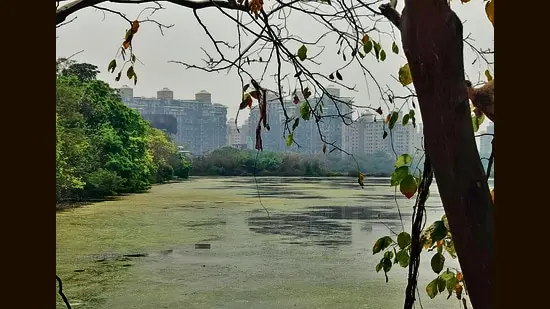
NAVI MUMBAI: The Thane District Wetland Monitoring Committee’s recommendation that eight water bodies in Navi Mumbai and Thane should not be recognised as wetlands has triggered a major confrontation within the state’s administrative machinery. The latest opposition to the committee’s report, whose recommendations were made available earlier this month, comes from the state forest and mangrove departments headed by forest minister Ganesh Naik.
The controversy centres on flamingo habitats including TS Chanakya lake, NRI wetland (Flamingo Point), DPS lake, Jewel of Navi Mumbai, Lotus lake, Ganesh Mandir lake, Gothivali lake, Jijamata creek and Nilje lake.
The district wetland committee, under the Thane district collector, states that none of the sites qualifies as a wetland under the Wetlands (Conservation and Management) Rules, 2017. The committee argues that that several of these sites are artificial, heavily modified or historically linked to salt pans, paddy cultivation, drainage infrastructure and planned urban development.
In the case of NRI wetland, the panel relied on CIDCO’s stand that the area fell within a planned development zone, where global tenders had earlier been floated for a golf course project. Similar development-linked arguments were cited for TS Chanakya lake, while the committee says the artificially created ‘Jewel of Navi Mumbai’ lake functions as a stormwater management system rather than a natural wetland.
The forest and mangrove departments have formally communicated their objections to the report and have sought legal protection for these sites under the Wetlands Rules, 2017.
The issue has become politically explosive as CIDCO functions under the state urban development department headed by deputy chief minister Eknath Shinde, while Ganesh Naik is the strongest political voice opposing the wetland committee recommendations and CIDCO’s land disposal policies in Navi Mumbai.
Naik has directly challenged the committee’s findings, questioning how they could contradict wetland reservations already reflected in the Navi Mumbai Municipal Corporation’s development plan.
“I told collector Shrikrishna Panchal that the environment of the district is under his leadership. Yet eight to ten water bodies that we recognise as wetlands are being declared non-wetlands. The report had not yet been finalised. Had we not aggressively intervened before confirmation of the minutes, these plots would have gone out for sale,” Naik said.
Naik also questioned why the mangrove department’s objections were not adequately considered before the committee arrived at its conclusions. “These areas have mangrove buffer zones and ecologically sensitive habitats. How can such a report be prepared without taking the mangrove department into confidence,” he asked.
“If the NMMC development plan itself reserves these areas as wetlands, on what basis can the district committee suddenly say they are not wetlands?” he said.
Responding to the objections, collector Shrikrishna Panchal told HT, “The committee’s findings are based on data, historical records and urban planning arguments submitted by CIDCO and its stand on the issue. We have not yet recommended the findings to the state government.”
He added, “I will be appointing two more experts to the committee as per the government GR, and the NMMC’s views will also be taken into consideration before the issue is finalised. The matter has been pending for several years because of various representations and developments and is still under review,” Panchal added.
Environmentalists warn that stripping these sites of wetland status would weaken legal safeguards and expose critical flamingo habitats to reclamation and development pressures. “If thousands of flamingos continue returning to these water bodies every year, how can they suddenly be treated as ordinary development plots,” asked B N Kumar of Natconnect Foundation. “Once protection tags are removed, such water bodies become vulnerable to reclamation and destruction,” said Rekha Sankhala of the Save Flamingos and Mangroves Forum.