



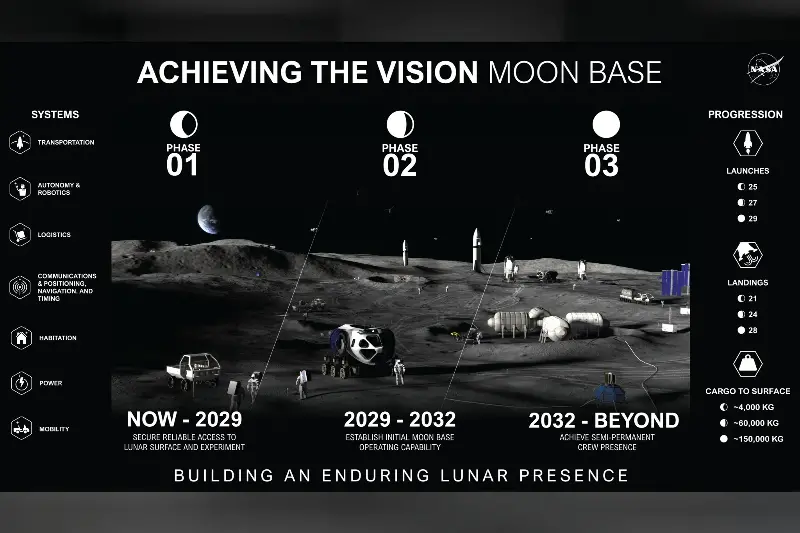
NASA has outlined a multiphase plan to establish a lasting human presence on the moon, with renderings of the technologies expected to support that effort.
The U.S. is refocusing its space strategy on the moon as global competition intensifies and commercial space capabilities advance.
The project also highlights intensifying global competition in space exploration, with the U.S., China and commercial space companies racing to establish a lasting foothold beyond Earth.
“The Moon Base is home base for Artemis astronauts who will live and work at humanity’s first lunar outpost,” the space agency said.
“NASA is leading global teams of innovators across international space agencies, industry, and academia to build the Moon Base and establish an enduring human presence near the lunar South Pole for the benefit of all.”
What Will a Moon Base Look Like?
As Newsweek previously reported, a U.S. moon base would initially take shape through robotic landers, power systems, communications equipment, and uncrewed rovers testing performance on the lunar surface.
These early efforts would be followed by semi‑habitable modules, surface vehicles, and routine cargo deliveries to support short astronaut missions.
According to NASA, the lunar outpost will gradually evolve from robotic exploration missions into a continuously staffed base capable of supporting long-duration human missions and serving as a launch point for deeper space exploration.
NASA’s Three-Phase Plan for a Moon Base
NASA says development of the Moon Base will unfold in three major phases centered around the lunar South Pole.
An infographic released by NASA illustrates the phased expansion of the Moon Base from robotic exploration to a sustained human presence near the lunar South Pole.
Phase One: Robotic Missions and Surface Testing
The first phase, expected to run through 2029, will focus on robotic missions, technology demonstrations and preparations for future surface operations.
NASA says the phase will include:
- Up to 25 lunar missions, including 21 landings.
- Crewed and autonomous rovers for mobility trials and terrain preparation, alongside four “MoonFall” drones and communications satellites.
- Early demonstrations of navigation, communications and power systems capable of surviving prolonged lunar nights.
- Scientific payloads carried aboard landers and rovers.
- NASA says roughly four tons of payloads will be delivered during this stage to test technologies and surface performance.
Phase Two: Early Habitation Begins
The second phase, spanning 2029 to 2032, will transition toward semi-permanent infrastructure and early habitation systems.
- NASA plans to deploy expanded solar arrays and early nuclear surface power systems, potentially including fission reactors.
- Upgraded rovers, next-generation drones and the first habitation modules are also expected.
- Enhanced communications systems will aim to provide reliable connectivity across the lunar South Pole region.
- NASA estimates up to 60 tons of cargo could be delivered through as many as 24 lunar landings.
Phase Three: A Permanent Human Presence
The final phase, beginning in 2032 and continuing beyond, would scale operations into a continuously active lunar base with routine crew rotations and long-duration missions.
“This is when living and working on the Moon becomes a reality,” NASA said.
The agency says this stage will include:
- Semi-permanent habitats designed for long-term crew living and operations.
- Operational fission-based power systems capable of generating energy through extended lunar nights.
- Pressurized rovers for long-range exploration and scientific missions.
- Advanced logistics systems supported by autonomous and crewed vehicles.
- NASA estimates as much as 38 tons of cargo could eventually be delivered annually to support the growing outpost.
NASA Reveals Moon Drones, Rovers and Habitat Concepts
Alongside the road map, NASA released concept images and videos showing the technologies expected to support the lunar base, including drones, rovers and habitat designs.
MoonFall Drones
NASA says its MoonFall mission will deploy four highly mobile drones to survey the lunar South Pole.
The region is considered critical for future exploration but difficult to navigate using traditional rovers alone.
Based on technology developed for NASA’s Ingenuity Mars Helicopter, the drones would operate independently for roughly one lunar day—about 14 Earth days—using onboard instruments and high-definition cameras to map terrain and gather data.
NASA says the drones are specifically designed to access steep terrain and permanently shadowed regions that are difficult for rovers to reach.
JAXA Pressurized Rover
A pressurized rover developed by Japan Aerospace Exploration Agency (JAXA) is expected to be deployed during the second phase of the project.
The rover is designed to function as both a mobile habitat and a scientific laboratory. It allows astronauts to travel farther across the lunar South Pole and conduct research well beyond fixed landing sites.
The rover would support two astronauts for up to 30 days, and provide living space, research facilities and mission support systems while enduring the Moon’s harsh conditions.
NASA says it is expected to survive up to 150 hours in shadow and remain operational for roughly a decade.
Inside NASA’s Vision for a Lunar Outpost
NASA also released artist renderings depicting astronauts, habitats, power systems and cargo operations at the future lunar outpost.
Industry Reactions to NASA’s Moon Base Plans
In a social-media post, NASA Administrator Jared Isaacman said the “near impossible is becoming possible.”
He added: “We are building the Moon Base for all we will learn, the innovation that will improve life on Earth, the inspiration for the next generation of explorers, and to master the skills needed for where we will inevitably go next…Mars.”
Elon Musk, who founded the space technology company SpaceX, called the master plan for the permanent lunar presence “inspiring.”
Blue Origin, the space company founded by Jeff Bezos, posted on X: “Lunar Permanence is only possible with recurring access to the Moon, and it starts this year.”