



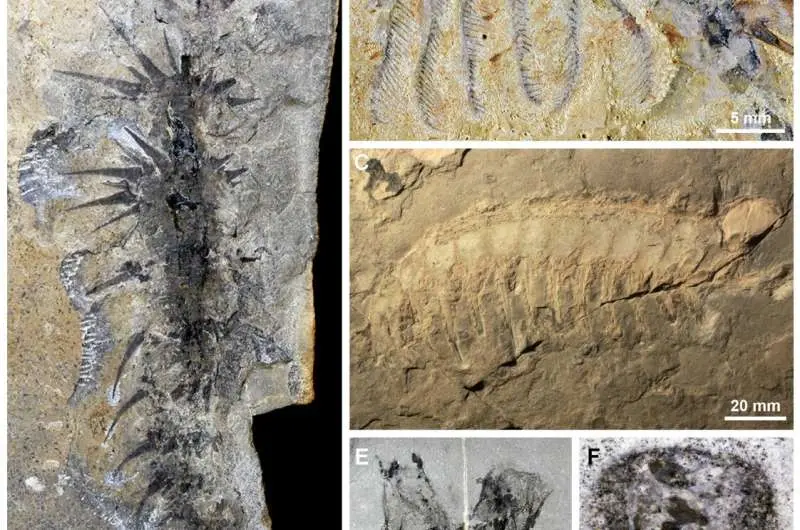
More than 500 million years ago, during what is known as the Cambrian period, the seas and oceans on Earth were filled with a myriad of marine animals, many of which have now become extinct. This evolutionary burst in new forms of life, referred to as the Cambrian explosion, paved the way for the evolution of many major animal groups that still populate our planet today.
The fascinating and mysterious marine animals dating back to the Cambrian period include so-called luolishaniids. luolishaniids are worm-like, soft-bodied animals belonging to a now extinct animal group called lobopodians. These strange worm-like creatures could be related to some contemporary invertebrates (i.e., animals without a backbone), such as velvet worms.
Researchers at Harvard University recently carried out a study aimed at better understanding how luolishaniids captured food from seawater, by studying fossils stored at different paleontology museums and institutes. The findings of their analyses, published in Biology Letters, suggest that luolishaniids may have sustained themselves by filtering tiny organisms from seawater via a mechanism known as suspension feeding.
"The early Paleozoic saw a dramatic diversification of shelly epibenthic metazoans adapted to suspension and filter feeding, but the extent to which these radiations affected the evolution of non-biomineralized suspension-feeding taxa is uncertain because these organisms are not typically well represented in the fossil record," Jared C. Richards and Javier Ortega-Hernández wrote in their paper. "Luolishaniids are a highly derived and disparate clade of (typically) armored lobopodians, widely interpreted as suspension feeders based on the presence of five or six anterior pairs of setulose appendages."
Diving into the mysteries of luolishaniids
Unlike animals with hard shells or skeletons, luolishaniids did not have any mineralized body parts. As a result, they would have been harder to preserve in fossils and fewer traces of them remain today.
Earlier studies have suggested that these animals were suspension feeders, which essentially means that they captured tiny living organisms or plankton from water currents. In fact, available fossils suggest that their front appendages were covered in fine comb-like structures (i.e., setules) that are often associated with suspension feeding.
"Luolishaniids are globally widespread and represent the only Cambrian non-biomineralized free-living epibenthic bilaterians suggested to have a suspension-feeding mode of life, but their proposed ecology relies solely on a qualitative interpretation of their functional morphology," wrote Richards and Ortega-Hernández. "We test the hypothesis that the setulose appendages of luolishaniids were adapted for a suspension-feeding function."
To test this long-standing hypothesis, Richards and Ortega-Hernández did not solely interpret existing luolishaniid fossils visually, they also performed measurements and statistical analyses. They specifically measured the spacing of the tiny hair-like structures on their feeding appendages and compared this size to their overall body length.
"Quantitative morphological comparisons reveal a positive and statistically significant relationship between body length and the mesh spacing of the setulose anterior limbs of luolishaniids," wrote the authors. "Standardized comparisons indicate that the body size disparity between luolishaniids (predators) and Cambrian mesoplankton (prey) is consistent with patterns observed in modern suspension-feeding organisms."
Shedding light on the evolution of modern marine animals
Collectively, the results of the team's analyses appeared to confirm the hypothesis that luolishaniids were suspension feeders. The researchers found that larger luolishaniids had wider comb-like water filtering structures, which resembled those observed in modern marine animals that filter organisms from the sea water.
"We provide quantitative evidence for suspension feeding in luolishaniids, which represents the first statistically supported example of modern-like predator–prey scaling patterns observed in Cambrian soft-bodied metazoans," wrote Richards and Ortega-Hernández. "Despite the uncanny appearance of luolishaniids, and Cambrian organisms more broadly, our results suggest their adaptations and mode of life feature ecological attributes shared with modern marine invertebrates."
In the future, this recent paper could help to paint a clearer picture of how the filter feeding mechanisms employed by some marine invertebrates evolved over time. Eventually, it could help to better understand how some modern marine invertebrates evolved and adapted in response to environmental changes on Earth.
Written for you by our author Ingrid Fadelli, edited by Lisa Lock, and fact-checked and reviewed by Robert Egan—this article is the result of careful human work. We rely on readers like you to keep independent science journalism alive. If this reporting matters to you, please consider a donation (especially monthly). You'll get an ad-free account as a thank-you.
Publication details
Jared C. Richards et al, Predator–prey scaling laws support a suspension-feeding lifestyle in Cambrian luolishaniid lobopodians, Biology Letters (2026). DOI: 10.1098/rsbl.2025.0650



© 2026 Science X Network
Citation: Strange 500-million-year-old marine fossils reveal a feeding strategy that still shapes oceans today (2026, May 13) retrieved 13 May 2026 from https://phys.org/news/2026-05-strange-million-year-marine-fossils.html
This document is subject to copyright. Apart from any fair dealing for the purpose of private study or research, no part may be reproduced without the written permission. The content is provided for information purposes only.