



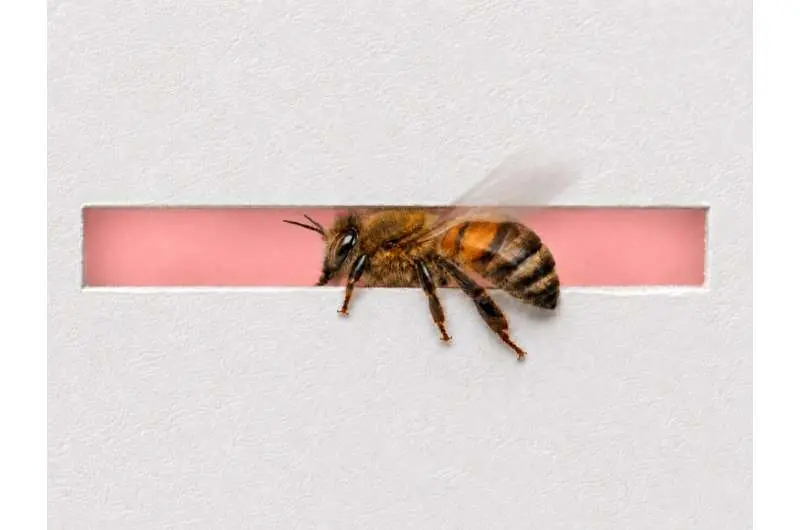
Honeybees are among the widely studied insects, due to their sophisticated, hierarchical social organization and their essential ecological role. Bees can move swiftly in natural environments, passing through narrow openings and identifying the best paths to reach their destinations without colliding with other objects.
Researchers at University of New South Wales Canberra recently carried out a study aimed at better understanding how honeybees decide what gap to fly through when there is more than one available option. Their findings, published in Biology Letters, suggest that the bees' judgments broadly follow a principle known as Weber's law, which suggests that animals assess differences based on the relative size of the choices, rather than their absolute size.
"Our research was inspired by a simple but fascinating question: how do animals make navigation decisions when moving through cluttered or spatially constrained environments?" Dr. Sridhar Ravi, senior author of the paper, told Phys.org. "Honeybees are excellent flyers and routinely travel through dense vegetation and narrow spaces during foraging. When flying between branches and through shrubs, they will be presented with various choices of apertures they can fly through. We still know relatively little about how they visually evaluate gaps and decide which route is safest."
How bees choose what gap to pass through
The main objective of this recent study was to shed more light on how bees make decisions when flying in cluttered environments. Specifically, they wanted to determine whether bees judge openings (i.e., gaps or apertures) in which to fly based on their absolute size or how large they are compared to other gaps.
"For example, do bees evaluate how wide a particular gap is and fly through it if it is large enough or do they rely more on relative differences between the available choices, as suggested in Weber's law?" said Ravi.
"Previous work has suggested that bees often respond more strongly to relative comparisons than absolute measurements, and we wanted to test whether that principle also applies during flight navigation. We also wanted to test how small a difference between openings bees can reliably detect and use when making decisions in flight."
By addressing these research questions, Ravi and his colleagues hoped to improve the present understanding of spatial perception in insects. To test their hypotheses, they designed and carried out a simple experiment, in which bees flew freely through a tunnel.
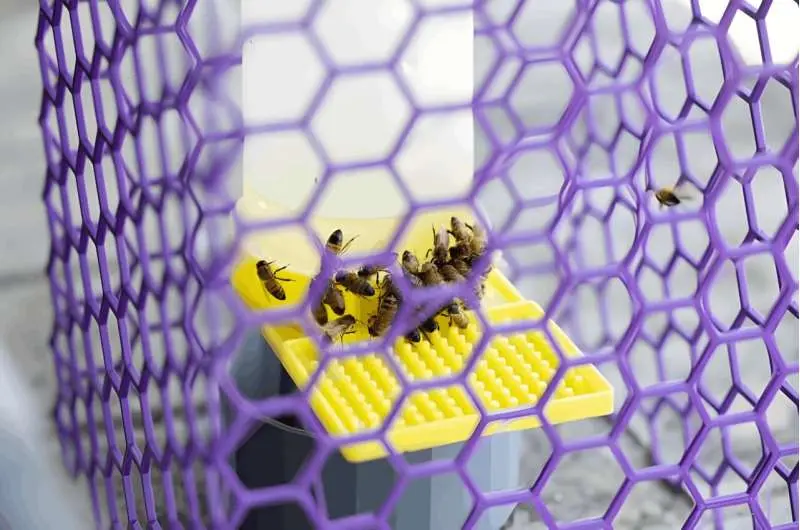
"We trained honeybees to fly through a tunnel that we constructed, where they would find a sugar solution reward," explained Ravi. "Once the bees became comfortable using the tunnel, they repeatedly flew into the setup, collected the sugar solution, returned to the hive, and then came back again. After the bees were familiar with the environment, we introduced a barrier inside the tunnel."
The barrier contained two rectangular openings, through which the bees could choose to fly. The width of these two openings was the same, while their heights were different.
"By systematically varying both the absolute size of the openings and the relative differences between them, we could observe how the bees made their choices," said Ravi. "This allowed us to test the bees' choices systematically. We were surprised by how elegant and context-dependent the bees' behavior turned out to be."
The results of the team's experiments suggest that bees do in fact choose what opening to pass through based on their relative size differences, but it was modulated by the absolute size as well. Their decisions appeared to be aimed at balancing safety with energy conservation.
"When the apertures were small, where the risk of collision is high, the bees appeared to carefully compare the options," said Ravi.
"As the relative difference between the openings increased, the bees' preferences became increasingly clear and predictable. However, when both apertures were already relatively large and safe to pass through, the bees behaved differently. In those situations, there was less need for a careful assessment because the risk of collision was already low. As a result, their choice between the options became much closer to random."
-
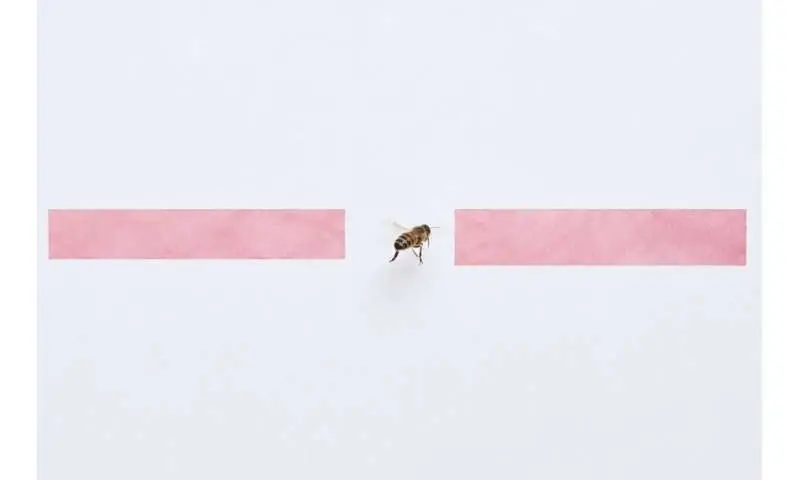
A frontal view of the aperture challenge from the monitoring camera, showing what the bees see on approach. Credit: UNSW Canberra. -
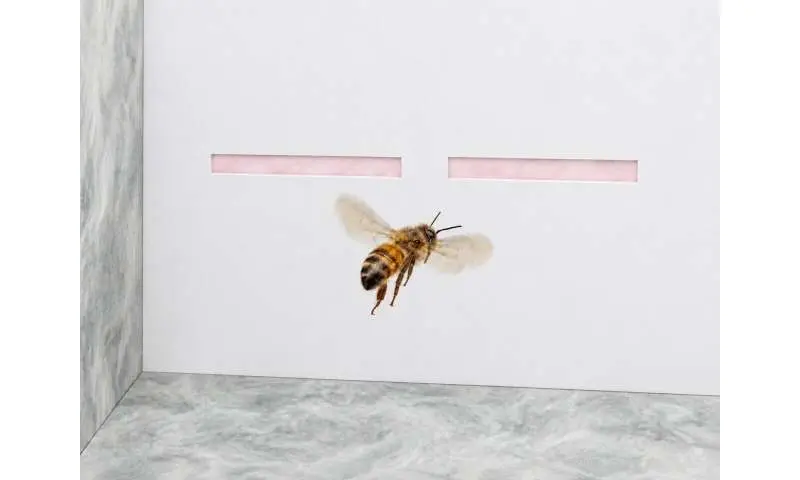
A bee deciding between two apertures with a subtle difference in height. Credit: UNSW Canberra.
Future research directions
This recent study showed that bees dynamically adjust the perceptual effort they invest in their navigation depending on the risk associated with different scenarios. Instead of comparing available apertures in rich visual detail, they appear to employ an efficient strategy that allows them to select the best option while consuming less energy.
"While this might seem like the most sensible approach for us humans, observing this in an insect with a tiny brain and small eyes makes it interesting," said Ravi.
The team's observations could help to improve existing theories of insect behavior. In the future, they could also inspire the development of new robotic systems or artificial intelligence (AI) models inspired by how honeybees navigate their surroundings.
"We think insect flight and navigation remain exciting areas from both a biological and engineering standpoint," said Ravi. "Bees are incredibly capable flyers and studying how they move through complex environments can teach us a great deal about perception, learning, and decision-making. One area we are becoming increasingly interested in is experience and learning."
As part of their next studies, Ravi and his colleagues plan to also explore the extent to which bees become better flyers over time, after repeated exposure to challenging environments. In addition, they hope to delineate the specific visual cues that guide the flight behavior of bees.
"We have recently completed a new set of experiments investigating whether bees can be 'tricked' by visual illusions that make apertures appear larger or smaller than they really are," added Ravi. "The results are very intriguing, but we will have to keep those findings under wraps for a little while longer until they are published."
Written for you by our author Ingrid Fadelli, edited by Gaby Clark, and fact-checked and reviewed by Robert Egan—this article is the result of careful human work. We rely on readers like you to keep independent science journalism alive. If this reporting matters to you, please consider a donation (especially monthly). You'll get an ad-free account as a thank-you.
Publication details
Timothy R. Jakobi et al, Threading the needle: spatial constraints sharpen visual sensitivity in honeybees, Biology Letters (2026). DOI: 10.1098/rsbl.2025.0849.



© 2026 Science X Network
Citation: Honeybees reveal Weber's law in flight when choosing paths (2026, May 23) retrieved 24 May 2026 from https://phys.org/news/2026-05-honeybees-reveal-weber-law-flight.html
This document is subject to copyright. Apart from any fair dealing for the purpose of private study or research, no part may be reproduced without the written permission. The content is provided for information purposes only.