



Dear Alex,
I am thinking about buying a hybrid, but there is a huge amount of misleading information on the internet. As far as I can gather, a hybrid runs on a combination of electricity and petrol, also recharging the battery by saving energy when braking or coasting. Whereas a plug-in hybrid (PHEV) only charges the battery when plugged in. However, it is very difficult to discover whether a PHEV also charges when braking or coasting; one model I found seems to work in this way, but is it the only one?
– AG
Dear AG,
The two main types are known as full hybrids (hybrid electric vehicle, or HEV) and plug-in hybrids (abbreviated to PHEV). There are also mild hybrids (MHEVs); the difference between the three essentially comes down to battery size, while each type has its pros and cons.
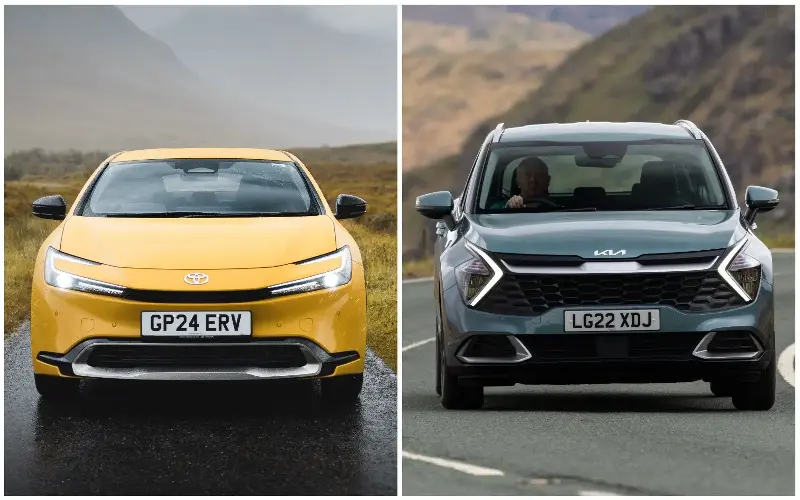
HEVs – the Toyota Prius being the most well-known example – came first and are also known as self-charging hybrids (which is something of a meaningless term because all hybrids self-charge). HEVs consist of a medium-sized additional battery which is charged by the engine acting as a generator, as well as through regenerative braking.
They cannot be plugged in. While they can travel short distances at low speeds on electric power alone, they exhaust their batteries quickly so can only really do so in slow-moving traffic or around car parks.
PHEVs have a larger battery that can store enough charge to power the car on electricity alone over greater distances – anywhere up to 80 miles or so – or aid the internal combustion engine, thus improving fuel economy. A popular example is the Kia Sportage family SUV.
All PHEVs can add extra charge through regeneration, like HEVs, although the amount they add is so little that it can’t come close to topping up the larger battery – in fact, it’s rare that you gain more than a mile or two of range this way. So to make them work at their best, you have to plug them in to recharge the battery.
MHEVs, such as the Suzuki Swift hatchback, have the smallest batteries of all. Their electric motors alone cannot drive the car, as a rule, instead adding extra power under acceleration.
Note that manufacturers sometimes describe an MHEV model as a hybrid, which is a bit cheeky because these are little more than an enhancement for small-capacity petrol and diesel engines.
So the car you found that works as both hybrid and PHEV is not unique. All PHEVs work like this. Nevertheless, a PHEV will only be at its most efficient if you plug it in regularly.
For expert advice, email [email protected] especially if you’ve had a bad experience with a dealer or manufacturer that you’d like us to look into. We will no longer be able to respond to every query, unfortunately.