



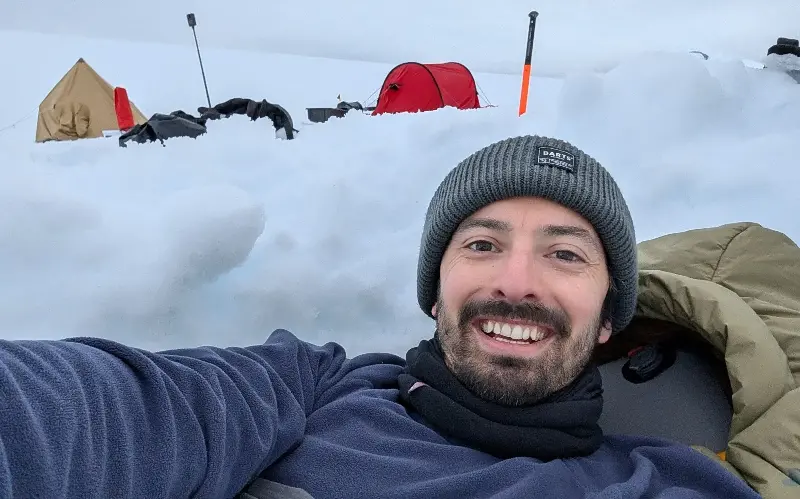
It is the middle of the night and I am lying in a pit dug into the ice, on a continent so hostile that the largest terrestrial animal is a 2cm-long flightless midge.
I am not alone. I can hear chattering and smell the guano from a gentoo penguin rookery a few hundred yards away. Closer, I can sense the shuffling and grunts of fellow humans.
Their presence brings no comfort to me. I am precisely 8,676 miles from home, it is minus-something degrees, and I have it on good authority that polar skuas like to peck the eyeballs out of their prey.
Right now, I look a lot like prey, as I have my face open to the ice-cold air and am cocooned in a bivvy bag. It is the closest I have been to being buried alive. And I begin to wonder, as the sun refuses to drop beneath the horizon, whether tomorrow will ever come.
A lottery system to decide the ‘lucky winners’
This scene, a line of tourists sleeping on the Antarctica ice, was more than half a century in the making.
In 1969, MS Lindblad Explorer was the first expedition cruise to operate off-ship excursions in Antarctica. Today there are more than 50 cruise firms operating on the seventh continent. As competition grows, and as the public’s appetite for authentic experiences intensifies, so does the demand for more extreme excursions.
On my HX Expeditions ship, the menu of activities – on which places are decided by lottery – included snowshoeing, sea kayaking and the “polar plunge”. The ultimate excursion, however, was to sleep on the ice in a bivvy bag.
With only 30 places available on a ship of 350 passengers, this was very much the golden ticket. Even so, once the places were allocated, I could sense bravado melting into nervous energy as we – the lucky winners – packed our gear into waterproof bags, boarded a zodiac boat and drifted off into the mid-summer night.
A fitful night, with moments of serenity
On arrival we were tasked with digging holes to sleep in, while a dozen or so camping couples erected their tents. The two expedition guides, mainly rugged ex-army sorts, insisted that the holes didn’t need to be too deep. And yet some dormant survival instinct told me that the deeper I dug, the warmer I would be. Later, I would discover my mistake.
With the bivvy holes dug, the expedition leaders gathered us for a team briefing.
The rules were as follows: no food, no drink (other than water) and in the morning we had to refill our holes and leave the snow flat. If not filled in, the holes can pose a trip hazard to penguins. If we needed anything during the night, one of the two guides would always be awake. There were also two portable toilets, strictly for “number ones”. After 11pm, it would be time for quiet.
Before retiring into my ice tomb for the night, I walked up to the nearby penguin rookery. I kept at least 5m (15ft) away from them, as the International Association of Antarctica Tour Operators (IAATO) rules dictate. But when I saw a pair toddling towards the campsite, it dawned on me that the gentoos do not observe the same rules. Just like that, a midnight penguin body-slam became the latest in my list of worries.
Back down the hill, some fellow campers I had befriended – three women from East Sussex and a German YouTuber and his cameraman – had constructed a makeshift card table in the snow. We were halfway through a game of Skip Bo when a Chinese tourist came and sat with us. He grabbed a few cards and pretended to play while his wife took photographs from all different angles. Then his friend joined and did the same. A cue, if ever there was one, to retire for bed.
I zipped myself fully into the bivvy and within minutes I felt the heating power of the sleeping bag. Stretching my arms either side, I could only move about 2.5cm before I touched the walls of my ice trench. A wider, more shallow hole, as advised, would have been less claustrophobic. Struggling to catch my breath, my only option was to expose my face to the cold night, and allow some cool air to circulate around me.
Minutes passed, hours, and I remained wide awake while the snores around me built up like a nasal orchestra.
In my pit, staring up at the white sky, I allowed my thoughts to wander, and they soon arrived at Shackleton. I thought of his team, who abandoned the crushed Endurance and for 170 nights slept on the ice, in reindeer-skin sleeping bags with the fur turned inwards to trap the heat. The sacks were prone to getting wet, meaning the crew would frequently wake up with the hide frozen stiff.
With that in mind, I took stock of my situation. I was lying in a top-of-the-range sleeping bag suitable for the planet’s coldest environments, in temperatures only a few notches below freezing, for just one night, with the safety of the HX Expeditions ship just a few hundred yards away, and survival guides on hand to assist – and a toilet, for heaven’s sake.
To the 2026 Antarctic tourist, the bivvy experience is the pinnacle of adventure. But in comparison to what past explorers endured, it is a night in a five-star hotel. Only then, with this serene sense of perspective in mind, did I briefly drift off to sleep.
How to do it
HX Expeditions offers a range of Antarctica itineraries with the opportunity to camp on the ice, either in a tent or a bivvy bag. The 12-day Highlights of Antarctica trip starts from £7,615pp, on an all-inclusive basis, with dozens of departures between now and March 2028. The bivvy bag camping experience can be booked (on a lottery basis) from £304 per person.