



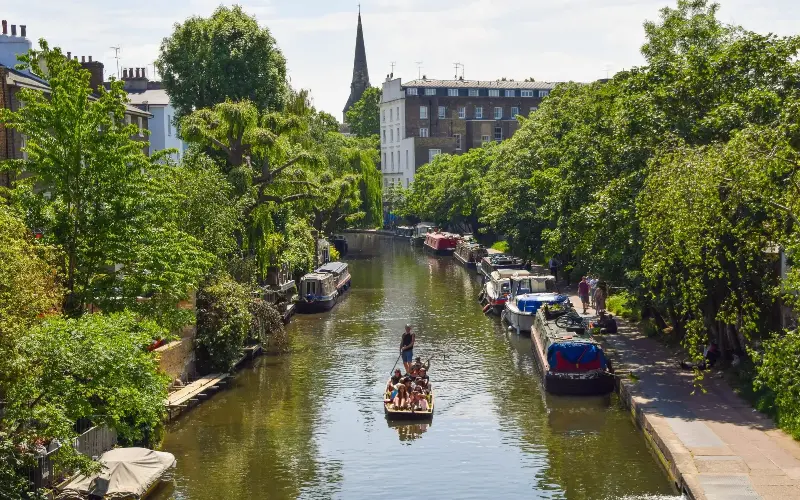
It seems that tourists are increasingly being put off visiting London’s borough of Camden – not least by news that its crime rate is officially the second highest in the city (surpassed only by Westminster). But for a visitor to London to miss out on one of its most mercurial, historic and magnificent districts is, to put it mildly, a crime in itself.
Camden is a place of constant surprises. Take, for example, that – despite its more recent roster of big-name locals (everyone from Dylan Thomas to Sean Thomas, and seemingly half the country’s musicians) – Charles Dickens may still be the borough’s most notable resident. Happily, he also makes a helpful protagonist when it comes to understanding the place.
As far as we know, he never went on the London Underground – despite the network opening in January 1863 and Dickens dying in 1870 (there’s a rumour – but no proof – that he feared trains, having survived a major accident). What we can be more certain of is that trains were responsible for erasing his childhood, not that he was entirely distraught by this. In his novel Dombey and Son, Dickens channels the destruction of his own home by the railways in his description of the demise of an old Camden street: “Where the old rotten summer-house once had stood, palaces now reared their heads, and granite columns of gigantic girth opened a vista to the railway world beyond.”
Not that Dickens lived, from the age of 10, a very happy life in Camden Town. His family occupied a cramped terraced house, and he slept in “a sort of cupboard some four and a half feet high, hanging over the stairway” and was forced to work in a factory from 12.
The landscape of his late childhood was defined by the arrival of successive railway lines, including the London and Birmingham and the North London. Camden – still just a geographical rather than an administrative description – was hewn and hemmed in by railway and became the frontier between new wealth and existing communities, between streetscape and railway world. In A Christmas Carol, poor Bob Cratchit lives in Camden Town in a mean old house.
A collision of industry and homestead
If the 18th century saw Hampstead become the primary outgrowth of London to the North – its independence and pastoral atmosphere preserved by Regent’s Park and Primrose Hill – in the 19th century, Camden Town dominated, even over neighbouring Kentish Town. Instead of pseudo-cottages and villas, Camden’s tangle of streets, canals and railway lines was filled in by warehouses and jerry-built terraces in grids. Over the tracks from the affluent streets of Gloucester Avenue and the rest of Primrose Hill, Camden was and still is a collision of industry and homestead.
Camden was an arrival point, but of a particular kind. Its most bucolic moment in literature – in Ford Madox Ford’s The Soul of London – describes the author hitching into the city on a cart bound for a hay market on Camden Town Road. “The sweet scent, the warmth and the half dozing” of the moving straw bed contrasts with “the thunder peals of shunting trucks, the clatter of cab-horse hoofs.” Camden was where work and play collided. Its major industry – how typically Camden is this? – became the manufacturing of pianos and other musical instruments, the scale of the outlets like the gorgeous Collard and Collard factory – its frontage still mimicking the curve of a grand – sitting right next to terraced homes.
Primrose Hill and Hampstead began as artisanal, bourgeois homesteads but became more affluent throughout the 20th century. The railways, though, brought Camden’s population to it. Central north London would become strongly flavoured by the Irish navvies, although it would be Kilburn to the west that became particularly known for its large Irish-born population. They brought with them and left behind a national infrastructure, which arrived in London at Camden. They also created places of entertainment – pubs in particular – that would ironically go on to give Camden its global reputation, more than the thing they came to work on.
The music scene moves in
Camden became the capital of north London – its tangled heart rather than its head – when the boroughs of Hampstead, Holborn and St Pancras were subsumed into it in 1965. What had once made Camden Town liminal, on the edge of the routes, suddenly made it, as Camden, central. Whereas the trains once disrupted its fabric, they now offered it depth. The Roundhouse was converted from a London and North Western Railway facility to a theatre, and in 1968 it hosted first the Doors and then Led Zeppelin’s first London show under that name. The gig served as the reception for Robert Plant’s wedding. Arguably the greatest ever bluesman, John Lee Hooker, was the support act.
The London music scene moved here in the 1970s and in doing so made Camden global. The Ramones’ gig at the Roundhouse in 1976 brought punk to London. The following night they played at Dingwalls, which had opened in 1973, with the Stranglers supporting. Pub venues such as The Falcon and The Black Horse had performance space. The Electric Ballroom, which opened in 1978, was converted from a dance hall, becoming the home of bands like Siouxsie and the Banshees and the Sex Pistols. Madness, known as the North London Invaders in their early days, had a residency at The Dublin Castle through 1979. Urban grit next to the pastoral open space of Regent’s Park, next door.
Coming into its own
In this way Camden played out of its beginning. Dickens spent his life thinking about how the child becomes the man, and his great characters all obliterate their childhood in some way: Lady Dedlock in Bleak House, or Pip in Great Expectations. Camden Market, which began in 1974 – the Stables Market serving as a railway warehouse – started out as a craft fair but quickly became a place where teenagers could go to pick and mix tribes and subcultures – two tone, goths, punk, hippy and later raver and indie kid.
New and secondhand clothes were sold in piles on stalls: drainpipe jeans, studded belts, secondhand suedette and denim jackets, DMs, plaid shirts and band T-shirts, Levi’s and a big belt: These were the costumes that allowed young people to become whom they thought they might want to be.
So, what of the stats that show Camden to have the highest crime rate of any London borough outside Westminster? Well, any place in a city where incomers and locals are thrown together will experience crime. Would you forego a trip to Montmartre just because Sacré-Cœur and Pigalle are pickpocketing hotspots and can be a bit sketchy late at night? Or does the frisson of urban encounter drive you there? It is the same for wider Camden. The area around Camden Town where the markets are – food has given way to fashion and music as its main driver – is as integral to London as a visit to places in the wider borough: the view from nearby Primrose Hill and a visit to Highgate Cemetery to the grave of Marx and others.
It is a place with a future too. The Museum of Youth Culture opens in Camden this summer. The Film Quarter is going through planning, and the Camden Highline, a ribbon park on old railway lines, has stalled but will one day flourish. Each generation will find what it needs to reinvent itself in Camden’s clamour, a metamorphosis to which you are daily invited. No visitor to London should miss out on the place that defined and nurtured so many of the city’s finest qualities.