



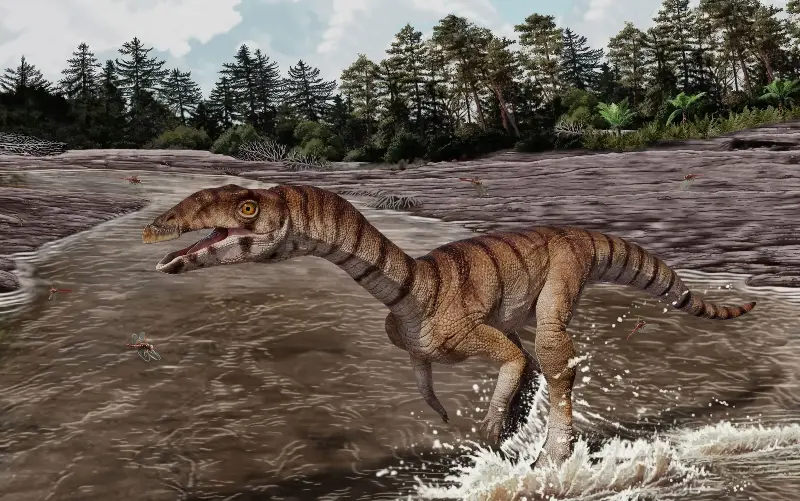
Crocodile ancestors stood upright like dinosaurs and had no teeth, scientists have discovered.
A new toothless, tiny-armed, bipedal species has been found in New Mexico, dating from the late Triassic, about 237 to 201 million years ago.
The bizarre creature, which also had a beak, has been nicknamed the “Witch Croc” and experts say it highlights the weirdness of life at the dawn of the dinosaurs.
Today’s crocodiles date back to about 17 million years ago, but they are preceded by shuvosaurs, a type of giant reptile.
Although the “Witch Croc” looks like a dinosaur, experts say it is a case of convergent evolution when two species evolve the same traits independently to exploit the same niche.
“Bipedalism is certainly a unique path for crocodile relatives to take, but it’s a path well-trod by dinosaurs and later birds. It obviously worked for these animals,” said Dr Alan Turner, of Stony Brook University, New York. “We see a lot of the successful strategies for modern animals and non-avian dinosaurs first arise in the Triassic, and shuvosaurs are a great example of that convergent evolution.”
The “Witch Croc” looked very much like ornithomimosaurs – a group of bipedal dinosaurs from the Cretaceous period whose bodies were similar to those of modern ostriches.
The Triassic was a period of biological experimentation, with evolution throwing up a host of strange species. It included the drepanosaurs, small tree-dwellers that looked like a cross between a chameleon and an anteater, with a massive sickle-shaped claw on their index finger.
There was also the extinct Longisquama, a reptile with long, feather-like structures growing from its back. Sharovipterygids glided using membranes of skin stretched between their limbs.
The “Witch Croc” fills a gap between two other shuvosaurs found in the region. Its scientific name – Labrujasuchus expectatus – reflects how scientists were “expecting” to find the missing link.
It was discovered in Ghost Ranch, a 21,000-acre area in Abiquiu, New Mexico, which has four quarries where Triassic fossils are regularly found by paleontologists.
The part of its name Labrujasuchus refers to the “Ranchos de los Brujos”, or Ranch of the Witches, an old Spanish name for Ghost Ranch.
“Legend has it, the local rancheros gave the site the name “Ranchos de Los Brujos” to keep folks away from the cattle-rustling operations of the Archuleta brothers,” said Dr Nate Smith of the Dinosaur Institute at the Natural History Museum in Los Angeles.
“We wanted to give a nod to that colourful history, and honour the incredible role Ghost Ranch has played in expanding our view of the Triassic. We also wanted to highlight how the fossil record works – finding one shuvosaur from earlier in the Triassic and one from later meant that we paleontologists knew there were probably more from in-between waiting to be discovered and described.”
The ancestors of crocodiles lived on land, and it was not until the Jurassic and Cretaceous periods, that the lineage moved into the water, developing flat skulls, powerful tails, and bony secondary palates that allowed them to breathe while semi-submerged. Their slow metabolisms and ability to eat most things allowed crocodile ancestors to survive the extinction event 66 million years ago that wiped out the dinosaurs.
The research was published in the Journal of Vertebrate Paleontology.