



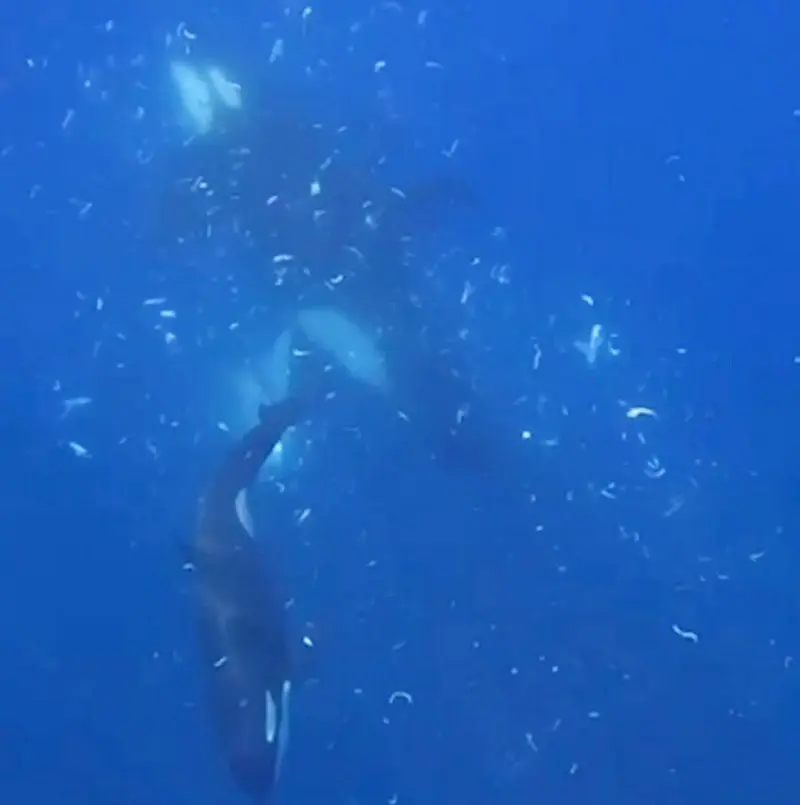
Killer whales have been seen smashing their prey into smithereens to make food for their calves.
In video footage, a female orca dangles a large sunfish from its mouth in preparation for its pod-mate to ram into it, shattering the creature into hundreds of pieces.
Experts believe the behaviour, which has never been seen before, could be a way of breaking down a large meal to make it more digestible for orca calves, in a similar way to how humans purée food for babies.
The ramming caused the sunfish’s tissue to fragment and float in the water, where the smaller parts were consumed by the juveniles of the group, while the adults ate the larger parts.
Dr Kathryn Ayres, a scientist at Beneath The Waves, a US non-profit organisation promoting ocean health, captured the footage in the Gulf of California in 2024.
“One orca holds the sunfish and lets go just before another orca hits it at high speed, causing the tissue to break apart into thousands of pieces,” she said.
“We think this may help younger orcas feed more easily or it could also just be for fun. Orcas are known for playing with their food.
“Orcas often tear apart prey and share it with other members of the group, including calves and juveniles.”
The behaviour was seen again in September 2025, when an orca was seen holding a sunfish, which was then rammed into, and broken apart, so that juveniles could feed. It was unclear whether the same orcas were involved in both events.
The sunfish were already dead in both cases, so the ramming is thought to be a processing technique rather than a means to finish off the fish.
Sunfish are one of the world’s heaviest fish and can grow to more than three metres long and weigh up to 4,400lb. In the original footage the impact was so intense that the orca was seen somersaulting away.
Experts say that both events suggest the killer whales were engaging “in a coordinated and cooperative strategy”, with one orca stabilising the carcass so the other could hit it more precisely.
Orcas are known to be ruthless and intelligent hunters, often working together to carry out strategic attacks to capture their prey.
In Argentina, killer whales use strong waves at high tide to push themselves onto the shore to catch sea lion pups then wiggle back into the sea.
Likewise in the Antarctic, orcas line up side by side and swim quickly towards the small icebergs which contain seals, creating a large wave that washes their prey into the water.
Orcas will also work together to herd schools of fish into a “bait ball” then strike the group with their tails to stun them, and will block the blowholes of smaller whales to suffocate them.
Ramming technique
Experts have suggested that the ramming may also be a way for the orca to access the bacterial content of the sunfish skin.
Sunfish skin and the gelatinous layer that covers their bodies – known as capsule – has a distinct microbiome which would become dispersed into the water when the body was shattered, and may be useful for the orca’s immune system.
The ramming behaviour may also have simply been a game for the killer whales who are known to play with their food, and are often seen throwing seals up into the air before eating them.
The team has called on conservationists to watch for the new behaviour.
“Collecting good identification photographs whenever possible is key: we are still seeing new techniques of how orcas hunt and process their prey,” Dr Ayres added.
“They’re one of the most iconic marine predators in the world, yet they continue to surprise us.”